The Cheat Code Comes With Instructions
Nobody reads a manual for fun, so here's one disguised as a real example: what should I actually expect from Josh Allen in Week 1, and how do I stop just staring at a number and hoping it likes me back?
The short version, for the skimmers
This site builds honest NFL stat projections from real historical data - roughly the same kind of math a sportsbook uses to set its own lines, just built by one person instead of a building full of quants, and shown to you plainly instead of buried under "terms and conditions apply." When our number and a sportsbook's number disagree, that gap is worth a second look. When they agree, congratulations, you and a multi-billion-dollar sportsbook are on the same page. Frame that.
Find the game (revolutionary, we know)
Head to By Game (or the hamburger menu on mobile, for the one person who still hasn't found it). Desktop shows every game already wide open, because your monitor can handle it. Mobile keeps every game collapsed by default, on purpose - showing you all of every game's guts at once on a phone screen turns the page into soup, and nobody wants soup. Tap the game you actually care about and it opens right up.
For this walkthrough, that's Bills @ Texans, Week 1. Riveting stuff. Keep going.
Read the Battle Cards before you fall in love with a player
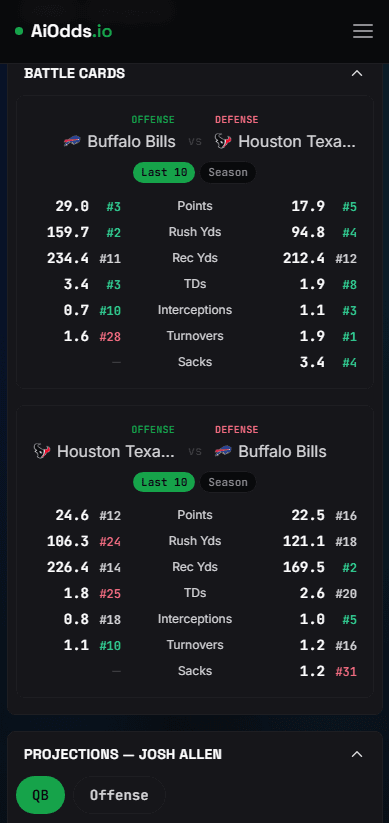
We call these Battle Cards because "Team Comparison Widget" sounds like something out of a spreadsheet, and this genuinely tells you who's going to win the trenches before either team has taken a snap. Offense vs. the opponent's defense, both directions, no digging required. Tap the "Last 10" / "Season" bubble to flip between recent form and the full-season picture - Last 10 is the default, because what a team did in Week 2 of last year has approximately zero bearing on Sunday.
Every number comes stamped with its league rank (1-32), so "#12 in receiving yards allowed" tells you instantly whether you're looking at a real strength, a real problem, or a whole lot of nothing in between. No math required on your end. That's our job.
Mobile
Check the projection against the matchup, not in a vacuum
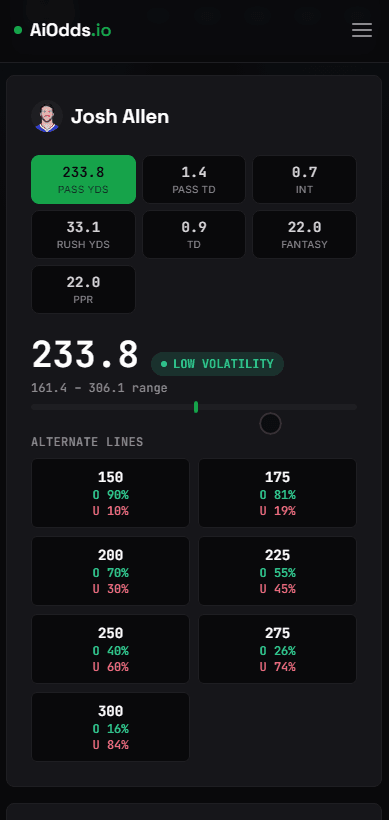
Scroll down and pick your player - Josh Allen in this case, because apparently we can't stop talking about him. The projection panel shows what the model expects across every relevant betting and fantasy category, weighted against the specific defense he's facing in whichever stat you've selected. It is not a Magic 8-Ball. It is doing actual work in the background so you don't have to.
Here's the actual reasoning, not just the number the model spat out: Houston's pass defense ranks a middling #12 - not scary, so Allen's passing-yards projection only gets nudged down a little from his raw baseline. But Houston's run defense ranks #4, genuinely mean, which is exactly the kind of matchup where a team quietly stops calling designed QB runs because nobody wants their franchise quarterback getting folded in half for 3 yards. The projection number won't say any of that out loud. You get there by reading the Battle Card and the projection together, which is the entire skill this site exists to teach you.
Mobile
Climb the probability ladder instead of guessing
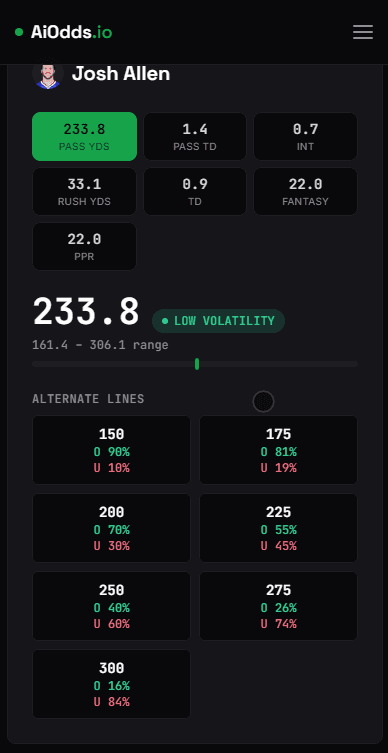
Scroll a bit further and you'll hit Alternate Lines - a full probability ladder for whatever stat you've got selected. This isn't "here's one number, good luck," it's "here's our confidence at every plausible line on the board": a 90% chance a QB clears 150 passing yards, fading down to a coin flip somewhere in the middle, all the way down to a real longshot at the top. If a sportsbook posts a line that our ladder says is unusually likely (or unusually not), that's not a coincidence worth ignoring.
Mobile
Sanity-check the model against actual human performance
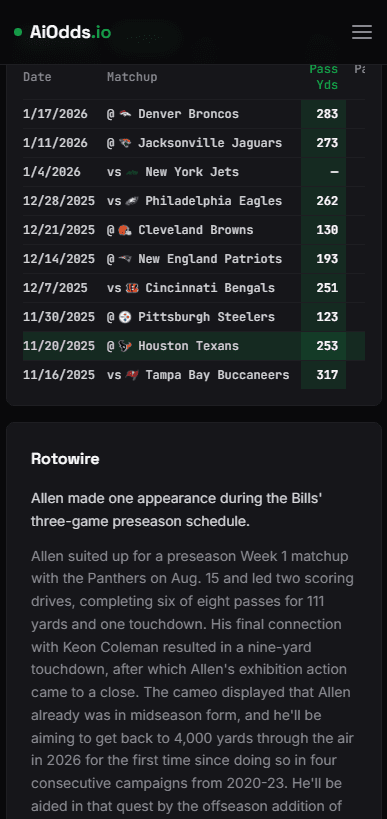
Below the projection sits the player's real game-by-game log - last 10 games, full season, or specifically against this exact opponent, same toggle as the Battle Cards. It scrolls sideways on mobile so every tracked stat still fits. This is the fastest gut-check on the whole site: does the projection roughly line up with what this guy has actually been doing on real grass, or does something look off? Your instincts still count here. The model doesn't get the final word, it gets a very well-informed opinion.
Mobile
Read the news. Actually read it. We're not kidding.
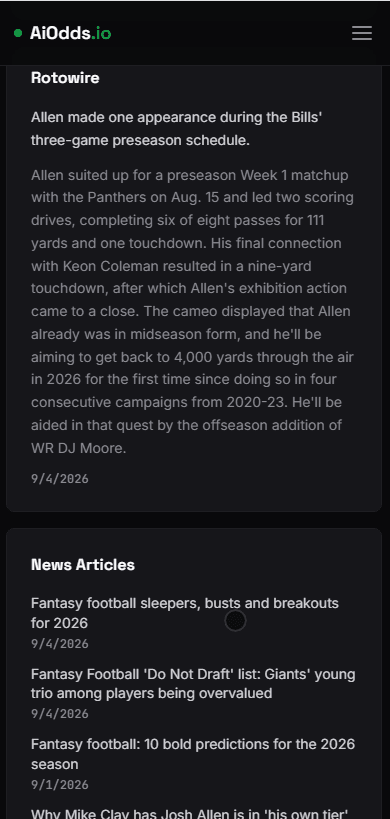
Every player card ships with a Rotowire blurb - the one thing you actually need to know about them right now, no scrolling required - plus a feed of the most recent articles that mention them. This exists to patch a real hole in the model, which we'll fully confess to in a second: the projection has no idea if someone's currently held together with tape. This is where you find out before you don't.
Mobile
Go check our work against an actual sportsbook
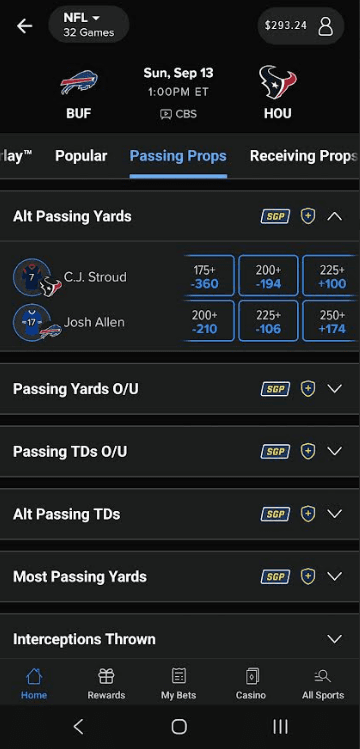
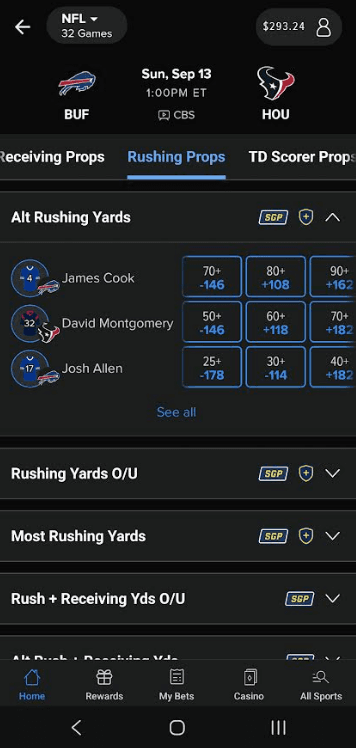
Here's the part we're actually proud of. In this same Week 1 matchup, FanDuel priced Josh Allen around 225 passing yards and roughly 30 rushing yards. We projected 233.8 passing yards and 33.1 rushing yards - independently, from nothing but our own NFL statistical model. Zero sportsbook data went into that number. We didn't peek.
That closeness is the whole pitch: it means one person's model is landing in the same neighborhood as a sportsbook with a legal team and a marketing budget, using a comparable approach built completely independently. When our number and a book's line agree, that's a real sanity check on both of us. When they land far apart, that gap is exactly the kind of thing worth digging into before you bet it - or bet against it. That gap is the entire point of this website.
Passing Props
Rushing Props
⚠️ The One Thing We'll Fully Own Up To
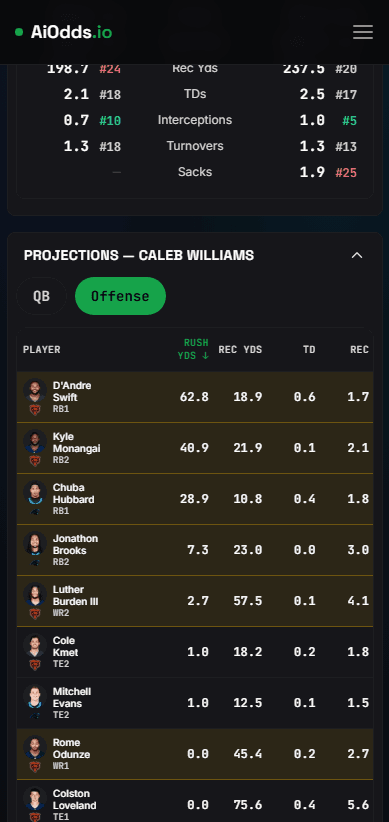
The model does not currently know if a player is hurt, limping, or held together by tape and hope, and it will not adjust a single projection for it - including the upside that opens up for whoever's stepping into the bigger role. That's not an oversight we're hoping nobody notices, it's a real gap we're telling you about ourselves: doing this properly needs real historical injury data to test it against, and that data only started accumulating this season. It goes into the model for real once there's an actual track record to trust instead of a vibe.
Until then, here's the duct tape: injured and questionable players are clearly flagged right in the player list on the very By Game page you've had open this whole time (same deal on every team's roster page), and you should always read the news blurb before trusting a projection at face value. If an entire receiving corps shows up questionable going into Sunday, that's not something a raw stat projection is ever going to catch on its own - no matter how confident the number looks.
Mobile
The Whole Workflow, for People Who Skipped to the Bottom
- Open the game on By Game
- Read both Battle Cards - know the matchup before you fall for any one player
- Check the player's projection against what the Battle Cards say about this exact opponent
- Use the probability ladder to judge a specific line, not just the headline number
- Sanity-check it against their real recent game log
- Read the news blurb. Always. We mean it.
- Compare against a real sportsbook line and go find the gap
Want the actual math behind the projections, no cheat-code metaphors this time? Read How It Works. Forgot what "alt line" or "juice" means and too proud to ask a friend? The Betting Glossary has you.